Comparing Growth Hormone Secretagogues: CJC-1295, Ipamorelin, Hexarelin, Tesamorelin, Sermorelin, GHRP-2, and GHRP-6

Growth hormone secretagogues are one of the most discussed categories in peptide research. They are popular in fitness, recovery, body composition, longevity, sleep, and hormone-optimization conversations because they relate to the body’s natural growth hormone signaling system.
But not all growth hormone peptides work the same way.
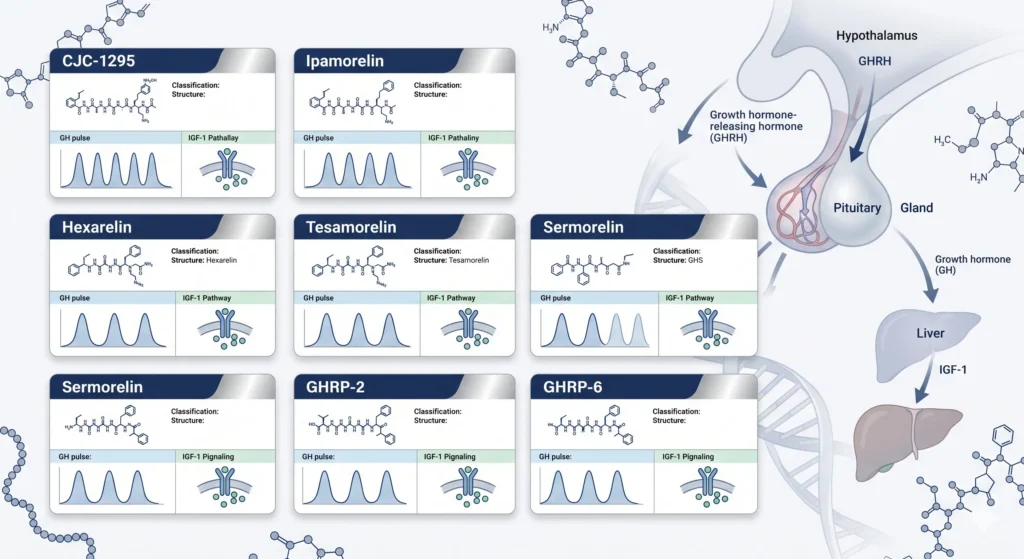
Some compounds stimulate the pituitary gland through the growth hormone-releasing hormone pathway. Others act through the growth hormone secretagogue receptor, also called the ghrelin receptor. Some are more selective. Some are stronger. Some have approved medical uses. Others remain research compounds without broad approval for wellness, anti-aging, recovery, or body-composition use.
Comparing Growth Hormone Secretagogues: CJC-1295, Ipamorelin, Hexarelin, Tesamorelin, Sermorelin, GHRP-2, and GHRP-6
Growth hormone secretagogues are one of the most discussed categories in peptide research. They are popular in fitness, recovery, body composition, longevity, sleep, and hormone-optimization conversations because they relate to the body’s natural growth hormone signaling system.
But not all growth hormone peptides work the same way.
Some compounds stimulate the pituitary gland through the growth hormone-releasing hormone pathway. Others act through the growth hormone secretagogue receptor, also called the ghrelin receptor. Some are more selective. Some are stronger. Some have approved medical uses. Others remain research compounds without broad approval for wellness, anti-aging, recovery, or body-composition use.
The most commonly discussed GH-related peptides include CJC-1295, Ipamorelin, Hexarelin, Tesamorelin, Sermorelin, GHRP-2, and GHRP-6.
This article compares how they work, why they are discussed, and what makes each one different.
What Is a Growth Hormone Secretagogue?
A growth hormone secretagogue is a compound that stimulates the body to release growth hormone, usually through the pituitary gland.
Growth hormone, often shortened to GH, is released in pulses. It plays a role in growth, body composition, fat metabolism, tissue repair biology, bone health, and IGF-1 signaling. IGF-1 stands for insulin-like growth factor 1, which is one of the major downstream signals associated with GH activity.
A secretagogue does not replace growth hormone directly. Instead, it signals the body to release more of its own GH.
That distinction matters. Direct growth hormone replacement and GH secretagogues are not the same thing. Secretagogues depend on the body’s ability to respond through the hypothalamus, pituitary gland, and GH/IGF-1 axis.
A scientific review on growth hormone secretagogues explains that these compounds have been studied because GH can affect lean body mass, fat mass, exercise tolerance, and muscle strength, while also noting that long-term GH-related safety remains complex. The Safety and Efficacy of Growth Hormone Secretagogues
Two Main GH Peptide Categories
GH-related peptides usually fall into two major categories.
The first category is GHRH analogs. These compounds mimic growth hormone-releasing hormone, the natural hypothalamic hormone that signals the pituitary gland to release GH. Examples include CJC-1295, Sermorelin, and Tesamorelin.
The second category is growth hormone-releasing peptides, also called GHRPs or growth hormone secretagogues. These compounds act through the growth hormone secretagogue receptor, which is related to ghrelin signaling. Examples include Ipamorelin, Hexarelin, GHRP-2, and GHRP-6.
A simple way to think about it:
GHRH analogs tell the pituitary, “Release GH.”
GHRPs and secretagogues stimulate GH release through the ghrelin/secretagogue receptor pathway.
Both categories can influence GH release, but they are not identical.
CJC-1295: The Long-Acting GHRH Analog
CJC-1295 is often grouped with growth hormone secretagogues, but technically it is best described as a growth hormone-releasing hormone analog, or GHRH analog.
GHRH is the natural hormone that tells the pituitary gland to release growth hormone. CJC-1295 was designed to mimic and extend that signal.
A human study published in The Journal of Clinical Endocrinology & Metabolism found that subcutaneous CJC-1295 produced sustained, dose-dependent increases in GH and IGF-1 levels in healthy adults. Prolonged stimulation of GH and IGF-1 secretion by CJC-1295
That is why CJC-1295 is usually discussed as a longer-acting GH-axis peptide rather than a short pulse peptide.
How CJC-1295 Is Usually Positioned
CJC-1295 is usually discussed for:
GH pulse support.
IGF-1 pathway research.
Recovery and body-composition conversations.
Longer-lasting GH signaling.
Combination use with Ipamorelin.
The reason CJC-1295 is often paired with Ipamorelin is that they work through different GH-related pathways. CJC-1295 supports the GHRH side of signaling, while Ipamorelin works through the secretagogue/ghrelin receptor side.
That combination is popular because it creates a two-pathway GH signaling concept.
CJC-1295 Strengths
The biggest strength of CJC-1295 is its sustained GH and IGF-1 signaling profile.
It is not usually discussed as the sharpest GH pulse peptide. Instead, it is discussed as a longer-duration GHRH analog that may support more sustained GH-axis activity.
It is also one of the better-known GH peptides in human research because of published data showing increases in GH and IGF-1.
CJC-1295 Caution Points
The same thing that makes CJC-1295 interesting also creates caution: it can increase IGF-1.
IGF-1 is biologically active. Higher IGF-1 signaling is not automatically desirable for everyone. Medical history, age, glucose metabolism, cancer history, cardiovascular risk, and endocrine status all matter.
A responsible article should not frame CJC-1295 as a casual anti-aging peptide. It is a GH-axis compound that deserves medical context and safety awareness.
Ipamorelin: The Selective GH Secretagogue
Ipamorelin is one of the most popular growth hormone secretagogues in wellness and fitness peptide discussions.
It is often described as a selective GH secretagogue because it was studied for its ability to stimulate GH release without the same level of ACTH or cortisol stimulation seen with older compounds like GHRP-2 and GHRP-6.
A PubMed-indexed study described Ipamorelin as the first selective growth hormone secretagogue and reported that GHRP-2 and GHRP-6 increased ACTH and cortisol, while Ipamorelin did not show the same ACTH/cortisol release pattern in that study. Ipamorelin, the first selective growth hormone secretagogue
That selectivity is why Ipamorelin is often viewed as the “cleaner” or more targeted option in GH secretagogue discussions.
How Ipamorelin Is Usually Positioned
Ipamorelin is usually discussed for:
GH pulse stimulation.
Recovery research.
Sleep and nighttime GH rhythm conversations.
Body-composition support discussions.
Pairing with CJC-1295.
A key reason Ipamorelin is popular is that it is generally discussed as less aggressive than older GH-releasing peptides. It is commonly framed as targeted, selective, and potentially better tolerated in comparison with stronger secretagogues.
That does not mean it is risk-free. It means its research profile is different from compounds like Hexarelin, GHRP-2, and GHRP-6.
Ipamorelin Strengths
The biggest strength of Ipamorelin is selectivity.
It is usually discussed as a GH pulse peptide that may have less impact on cortisol and prolactin compared with some older secretagogues.
That makes it appealing in conversations about recovery, sleep, and body composition because people often want GH-related signaling without feeling overstimulated, hungry, or hormonally disrupted.
Ipamorelin Caution Points
Ipamorelin is still a biologically active GH secretagogue. It is not just a supplement.
Any compound that influences GH and IGF-1 pathways deserves caution, especially in people with endocrine disorders, glucose issues, cancer history, pregnancy, active illness, or complex medication use.
Product quality also matters. Research-labeled peptides sold online may not match regulated standards for identity, purity, sterility, or concentration.
Hexarelin: The Stronger GH-Releasing Peptide
Hexarelin is another growth hormone secretagogue. It is usually described as a potent GH-releasing peptide.
A human study reported that Hexarelin stimulates growth hormone release both in vitro and in vivo. Growth hormone-releasing activity of hexarelin in humans
Compared with Ipamorelin, Hexarelin is often discussed as more powerful. That is why it gets attention from people interested in stronger GH pulses.
But stronger is not automatically better.
How Hexarelin Is Usually Positioned
Hexarelin is usually discussed for:
Potent GH release research.
GH secretagogue receptor activity.
Recovery and body-composition conversations.
Comparison against Ipamorelin and other GHRPs.
Advanced GH-axis research discussions.
It belongs in the same overall GH category as Ipamorelin, GHRP-2, and GHRP-6, but it is usually treated as a stronger and less subtle compound.
Hexarelin Strengths
The biggest strength of Hexarelin is potency.
In research discussions, it is commonly framed as one of the stronger GH-releasing peptides. That makes it interesting in comparisons because it may stimulate a more forceful GH response than more selective options.
For peptide education, Hexarelin is useful because it shows the difference between “selective” and “strong.”
Hexarelin Caution Points
The biggest caution with Hexarelin is that potency may come with more endocrine complexity.
Older GH-releasing peptides have been associated in some research discussions with broader hormonal effects, including possible effects on prolactin, ACTH, or cortisol depending on the compound and dose context. That is one reason Ipamorelin is often described as more selective.
Hexarelin should not be treated as a beginner-friendly wellness peptide or a casual recovery shortcut. It is a potent GH secretagogue and should be discussed with more caution.
Tesamorelin: The Clinically Approved GHRH Analog
Tesamorelin is one of the most important compounds in this comparison because it has an approved medical context.
Tesamorelin is a synthetic growth hormone-releasing factor analog. The FDA prescribing information describes tesamorelin as a human growth hormone-releasing factor analog produced synthetically and indicates it for the reduction of excess abdominal fat in adults with HIV and lipodystrophy. FDA Prescribing Information: EGRIFTA SV
That matters because Tesamorelin is not just a generic wellness peptide. It is a prescription medication with a specific approved use.
How Tesamorelin Is Usually Positioned
Tesamorelin is usually discussed for:
GH-releasing factor activity.
HIV-associated lipodystrophy.
Visceral abdominal fat research.
Metabolic health discussions.
Clinical GH-axis signaling.
Unlike many wellness-market peptides, Tesamorelin has a defined regulatory and clinical context. That gives it a different status than research compounds discussed for general recovery or anti-aging.
Tesamorelin Strengths
The biggest strength of Tesamorelin is its clinical legitimacy for a specific indication.
It is a GHRF analog with an approved role in reducing excess abdominal fat in adults with HIV-associated lipodystrophy.
That makes it one of the more medically established compounds in the GH-related peptide category.
Tesamorelin Caution Points
Tesamorelin’s approved use does not mean it is a general fat-loss or anti-aging peptide.
Its indication is specific. It is not approved as a bodybuilding peptide, casual weight-loss peptide, or broad longevity therapy.
It also works through GH and IGF-1-related pathways, which means safety considerations still matter. The prescribing information includes warnings and monitoring considerations, including IGF-1-related concerns.
Sermorelin: The Classic GHRH Fragment
Sermorelin is a synthetic analog of growth hormone-releasing hormone. It is a 29-amino-acid fragment of endogenous human GHRH, often described as GHRH 1-29.
A review of Sermorelin described it as a well-tolerated GHRH analog suitable for use as a provocative test of growth hormone deficiency when administered as a single intravenous dose. The review also noted limited data suggesting daily subcutaneous Sermorelin promoted growth in some prepubertal children with idiopathic growth hormone deficiency. Sermorelin review
In wellness settings, Sermorelin is often discussed as a GH-supporting peptide because it stimulates the pituitary through the GHRH pathway.
How Sermorelin Is Usually Positioned
Sermorelin is usually discussed for:
GHRH pathway stimulation.
GH deficiency testing history.
GH pulse support.
Age-management clinic discussions.
Pituitary-dependent GH release.
Sermorelin is different from direct GH replacement because it relies on the pituitary gland responding to the GHRH signal.
Sermorelin Strengths
The biggest strength of Sermorelin is that it works through a more physiologic upstream signal: GHRH.
It is often framed as gentler or more “natural” in concept because it stimulates the pituitary rather than replacing GH directly.
It also has a long history in GH testing and endocrine research.
Sermorelin Caution Points
Sermorelin depends on pituitary responsiveness. If the pituitary cannot respond properly, stimulating it may not produce the desired GH release.
It is also often marketed more broadly than the evidence supports. Claims about anti-aging, fat loss, muscle growth, or recovery should be treated carefully.
GHRP-2: The Stronger Classic GHRP
GHRP-2 is one of the older growth hormone-releasing peptides. It acts through the growth hormone secretagogue receptor pathway and has been studied for its ability to stimulate GH release.
GHRP-2 is often discussed as stronger than GHRP-6 in terms of GH response, but it may also have broader hormonal effects. In the Ipamorelin comparison study, GHRP-2 increased ACTH and cortisol, while Ipamorelin did not show the same pattern. Ipamorelin, the first selective growth hormone secretagogue
A review on growth hormone secretagogues also discusses GHRP-2 research in GH-deficient children and broader human studies. The Safety and Efficacy of Growth Hormone Secretagogues
How GHRP-2 Is Usually Positioned
GHRP-2 is usually discussed for:
Stronger GH pulse stimulation.
Classic GHRP research.
Comparison with GHRP-6.
GH deficiency and growth studies.
Broader endocrine activity.
It is often described as more potent than GHRP-6, but also less selective than Ipamorelin.
GHRP-2 Strengths
The biggest strength of GHRP-2 is GH stimulation.
It is one of the classic research peptides in this category and has been studied in human GH-release contexts.
It is useful as a comparison compound because it helps show how older secretagogues differ from newer, more selective compounds like Ipamorelin.
GHRP-2 Caution Points
The biggest caution with GHRP-2 is broader hormone activity.
Because it may affect ACTH and cortisol in some studies, it is not usually considered as selective as Ipamorelin.
This is why it should be discussed as a stronger but less targeted GH secretagogue.
GHRP-6: The Appetite-Associated Classic GHRP
GHRP-6 is another classic growth hormone-releasing peptide. Like GHRP-2 and Hexarelin, it acts through the growth hormone secretagogue receptor pathway.
GHRP-6 is often discussed as a GH-releasing peptide with a stronger association with appetite signaling. That makes sense because the GHS receptor is related to ghrelin biology, and ghrelin is closely connected to hunger.
Scientific literature describes GHRP-2, GHRP-6, and Hexarelin as growth hormone-releasing peptides that have been shown to release GH in animals and humans. Growth Hormone-Releasing Peptides and Their Analogs
How GHRP-6 Is Usually Positioned
GHRP-6 is usually discussed for:
Classic GH secretagogue research.
GH pulse stimulation.
Appetite-related ghrelin pathway conversations.
Comparison with GHRP-2 and Ipamorelin.
Older-generation GH peptide research.
In fitness circles, GHRP-6 is often associated with hunger. That makes it less appealing for people focused on appetite control, but potentially interesting in research conversations involving ghrelin signaling and feeding behavior.
GHRP-6 Strengths
The biggest strength of GHRP-6 is that it is one of the foundational compounds in GH secretagogue research.
It helped shape the development and understanding of later GH secretagogues.
It is also useful for understanding the relationship between GH release and ghrelin-related appetite signaling.
GHRP-6 Caution Points
The biggest caution with GHRP-6 is that appetite stimulation and broader endocrine effects may be more prominent compared with more selective secretagogues.
That makes it less targeted than Ipamorelin and potentially less desirable in wellness contexts where appetite control is important.
Comparison Table
| Compound | Category | Main pathway | General identity | Main caution |
|---|---|---|---|---|
| CJC-1295 | GHRH analog | GHRH pathway | Long-acting GH and IGF-1 support | IGF-1 elevation and GH-axis concerns |
| Ipamorelin | GH secretagogue | GHS/ghrelin receptor pathway | More selective GH pulse peptide | Still biologically active, not risk-free |
| Hexarelin | GH secretagogue | GHS/ghrelin receptor pathway | Potent GH-releasing peptide | More endocrine complexity |
| Tesamorelin | GHRF analog | GHRH/GHRF pathway | Approved for HIV-associated lipodystrophy | Not a general fat-loss or anti-aging peptide |
| Sermorelin | GHRH analog | GHRH pathway | Classic pituitary GH-stimulation peptide | Depends on pituitary responsiveness |
| GHRP-2 | Classic GHRP | GHS/ghrelin receptor pathway | Stronger classic GH pulse peptide | Less selective, ACTH/cortisol concerns |
| GHRP-6 | Classic GHRP | GHS/ghrelin receptor pathway | GH release plus appetite-associated signaling | Hunger and broader endocrine effects |
Which One Is the Most Selective?
Ipamorelin is generally described as the most selective GH secretagogue in this group.
That does not mean it is the strongest. It means its research profile is often discussed as more targeted toward GH release with less broad hormone activity than older GHRPs like GHRP-2 and GHRP-6.
Which One Is the Most Clinically Established?
Tesamorelin is the most clinically established in this group because it has an approved prescription-drug context for reducing excess abdominal fat in adults with HIV-associated lipodystrophy.
That does not mean it is approved for general wellness, bodybuilding, or anti-aging. Its approved use is specific.
Which One Is the Longest Acting?
CJC-1295 is the longer-acting GH-axis peptide in this comparison.
Its purpose is not simply to create a brief GH pulse. It was designed as a long-acting GHRH analog, and human data show sustained GH and IGF-1 increases.
Which One Is the Strongest?
Hexarelin is usually discussed as one of the strongest GH-releasing peptides.
GHRP-2 is also often discussed as a stronger classic GHRP.
But stronger is not automatically better. More GH stimulation may also mean more need for caution, monitoring, and attention to broader endocrine effects.
Which One Is Most Associated With Appetite?
GHRP-6 is usually the one most associated with appetite conversations.
Because it works through ghrelin-related signaling, it is often discussed for its hunger-stimulating effects.
That may be relevant in some research contexts, but it may be undesirable for people focused on appetite control or weight management.
Why CJC-1295 and Ipamorelin Are Often Paired
CJC-1295 and Ipamorelin are often paired because they work through complementary pathways.
CJC-1295 mimics the GHRH signal.
Ipamorelin stimulates the GH secretagogue pathway.
The idea is that the GHRH pathway and secretagogue pathway may work together to support GH release more effectively than either pathway alone.
That is why the CJC-1295 and Ipamorelin combination is one of the most common GH peptide pairings in recovery and wellness conversations.
Why “Secretagogue” Does Not Always Mean the Same Thing
The word secretagogue gets used loosely in peptide content.
Strictly speaking, compounds like Ipamorelin, Hexarelin, GHRP-2, and GHRP-6 are classic GH secretagogues because they stimulate GH release through the GHS receptor pathway.
CJC-1295, Sermorelin, and Tesamorelin are better described as GHRH or GHRF analogs because they mimic the natural growth hormone-releasing hormone signal.
All of them may relate to GH release, but they are not identical categories.
What These Compounds Are Not
These compounds are not direct human growth hormone.
They are not guaranteed fat-loss compounds.
They are not guaranteed muscle-building compounds.
They are not approved anti-aging treatments.
They are not replacements for sleep, training, nutrition, or medical care.
They are not casual supplements.
They are GH-axis compounds that should be discussed with accuracy and caution.
Safety Considerations
Any compound that affects the GH/IGF-1 pathway should be treated carefully.
Possible concerns in GH-axis conversations may include:
Changes in IGF-1.
Water retention.
Joint discomfort.
Tingling or numbness.
Changes in blood sugar handling.
Endocrine effects.
Appetite changes.
Product quality concerns.
Injection-site issues.
Unknown long-term effects depending on the compound and use context.
The largest safety issue in the wellness peptide market is that many products are sold as research chemicals or non-approved compounds. Product quality may vary, especially with injectable products.
Any real human-use conversation should involve licensed medical oversight, appropriate lab work, medical history review, and a regulated supply chain.
Best Way to Talk About These Compounds
Better wording:
“CJC-1295 has been studied for sustained GH and IGF-1 increases.”
“Ipamorelin is discussed as a selective GH secretagogue.”
“Hexarelin is a potent GH-releasing peptide studied for GH secretagogue activity.”
“Tesamorelin is a GHRF analog with a specific approved medical use.”
“Sermorelin is a GHRH analog historically used in GH testing.”
“GHRP-2 and GHRP-6 are classic GH-releasing peptides studied for GH release.”
Avoid wording:
“Builds muscle.”
“Burns fat.”
“Reverses aging.”
“Heals injuries.”
“Boosts GH safely.”
“Works for everyone.”
This keeps the content more credible and avoids unsupported medical claims.
Final Takeaway
Growth hormone secretagogues are popular because they may influence the body’s own GH-release pathways. But the category is more nuanced than most online discussions make it seem.
CJC-1295 is the long-acting GHRH analog.
Ipamorelin is the selective GH secretagogue.
Hexarelin is the stronger GH-releasing peptide.
Tesamorelin is the clinically approved GHRF analog for a specific HIV-associated lipodystrophy indication.
Sermorelin is the classic GHRH fragment with a long history in GH testing and endocrine research.
GHRP-2 is the stronger classic GHRP with broader endocrine activity.
GHRP-6 is the classic appetite-associated GHRP.
The best compound is not automatically the strongest one. The better question is what pathway is being studied, what outcome is being measured, what evidence exists, and what safety tradeoffs may come with GH-axis stimulation.