Why Novis Life Is the Best Peptide Research Catalog on the Internet

Peptide research can get confusing fast. One page gives you a compound name. Another gives you a vague benefit claim. Another gives you a dosing range without context. Another talks about mechanisms but leaves out citations. For anyone trying to understand peptide research responsibly, the problem is not a lack of information. The problem is that the information is usually scattered, incomplete, or written like marketing.
That is where Novis Life stands out.
Novis Life is not just a list of peptide names. It is built like a research catalog. The platform organizes peptide information around mechanisms, research status, dose ranges, half-lives, related compounds, citations, and practical research tools. Instead of making the user jump between random websites, calculators, blog posts, and forum threads, Novis Life puts the key pieces of peptide research into one structured place.
That is why Novis Life makes a strong case as one of the best peptide research catalogs on the internet.
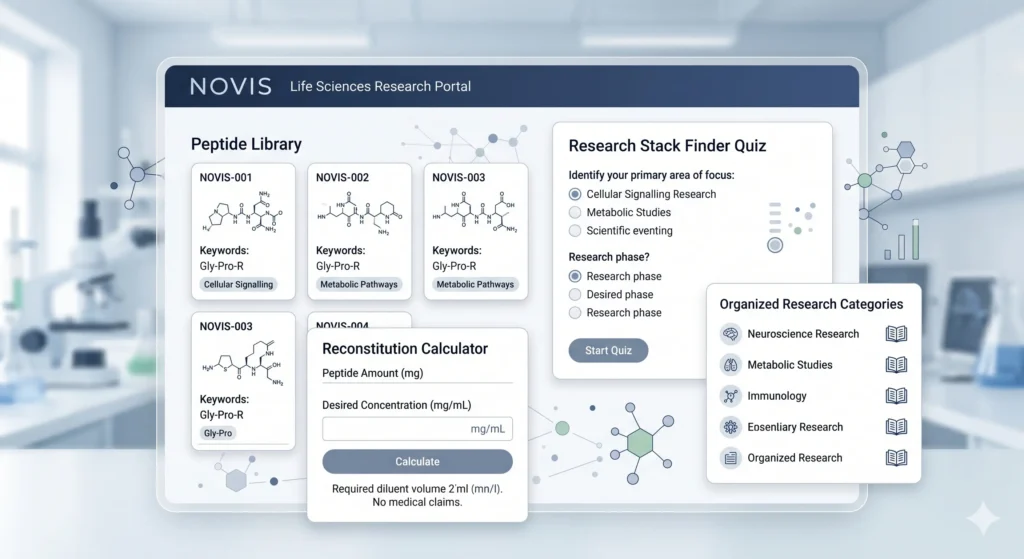
A Peptide Library Built for Clarity
The core of Novis Life is its Peptide Library. The library currently organizes 25 compounds across categories like Slim, Recovery, Longevity & Cognition, Skin & Hair, Gut Health, Immunity, Hormonal, and body composition.
That matters because peptide research is not one category. A metabolic peptide is not the same as a recovery peptide. A nootropic peptide is not the same as an immune peptide. A GLP-1 drug is not the same as a mitochondrial peptide. Novis Life makes those differences easier to understand by organizing each compound by research category and mechanism.
The library includes peptides and peptide-related compounds such as Retatrutide, Tirzepatide, Semaglutide, BPC-157, TB-500, MOTS-c, SS-31, GHK-Cu, DSIP, Semax, Selank, PT-141, VIP, LL-37, Kisspeptin-10, Epithalon, CJC-1295, and Ipamorelin.
Instead of treating every peptide like it does the same thing, Novis Life gives each compound its own research context.
It Focuses on Mechanisms, Not Just Hype
A good peptide catalog should not only say what people are talking about. It should explain why researchers are interested in the compound.
Novis Life does this by including mechanism-of-action sections on individual peptide pages. That is important because mechanisms are what separate real research education from generic peptide marketing.
For example, a compound like Ipamorelin is not just listed as a “recovery peptide.” Its page explains its role as a selective growth hormone secretagogue and describes how it relates to GH release pathways. That gives the reader a better understanding of why it appears in body composition, recovery, and hormonal research conversations.
This matters across the catalog. Peptide education becomes much more useful when the reader can understand the pathway behind the compound.
It Includes Research Parameters
One of the best parts of Novis Life is that it does not stop at basic descriptions. The platform includes research parameters like dose range, half-life, administration route, research status, and citation references.
That makes the catalog more useful as a reference tool.
Many peptide websites only give broad descriptions or benefit-based summaries. Novis Life goes further by giving the reader structured research details that make it easier to compare compounds.
For example, the site’s peptide pages are built around practical research questions:
What is the compound?
What category does it belong to?
What is the research status?
What is the mechanism?
What dose range appears in research contexts?
What is the half-life?
What are the related compounds?
What citations support the discussion?
That structure makes the information easier to scan, compare, and understand.
It Has a Reconstitution Calculator
Peptide research often involves math. Vial size, bacteriostatic water volume, concentration, dose amount, and syringe markings can become confusing quickly.
Novis Life addresses this with a Peptide Reconstitution Calculator. The tool is designed to help calculate bacteriostatic water volume and per-dose injection volume based on vial size, target concentration, dose amount, and syringe type.
This is one of the features that makes Novis Life more than a blog or simple compound directory. It gives the user a practical research tool that connects peptide education with protocol organization.
The calculator also reinforces an important point: peptide research requires precision. Guesswork, bad math, and unclear volume calculations can create confusion. Novis Life builds around the idea that research workflows should be organized, traceable, and specific.
It Has a Stack Finder
Another major feature is the Find Your Stack tool.
The Stack Finder asks five questions and maps research goals to peptide combinations. The inputs include the user’s main research objective, experience level, injection comfort, timeline, and priorities such as cost, safety, efficacy, and convenience.
That is a smarter approach than simply listing random peptide stacks.
A lot of peptide content online pushes generic combinations without explaining why those compounds belong together. Novis Life’s stack tool is built around goals and mechanisms, which makes the recommendation process more structured.
The important detail is that the Stack Finder is positioned as a research tool, not medical advice. That gives it a more responsible framework than many peptide recommendation pages online.
It Connects Related Peptides by Mechanism
Novis Life also links related peptides together. This is useful because peptide research often makes more sense when compounds are compared by pathway.
For example, someone reading about Ipamorelin may also want to understand CJC-1295. Someone reading about BPC-157 may want to compare it with TB-500 or the BPC-157 + TB-500 Stack. Someone researching Semaglutide may also want to compare it with Tirzepatide and Retatrutide.
This related-compound structure helps users move through the research logically instead of bouncing around the internet.
It Has a Research Journal, Not Just Product Pages
Another reason Novis Life stands out is its Journal.
The Journal expands beyond individual peptide pages and gives broader educational context. It includes articles on topics like Retatrutide, sleep and DSIP, mitochondrial peptides like MOTS-c and SS-31, GLP-1 drugs and blood sugar, injury recovery, inflammation, growth hormone signaling, and energy.
That matters because peptide research is not just about memorizing names. The better questions are:
How do peptides relate to recovery?
How do GLP-1 drugs affect blood sugar?
How does sleep affect peptide recovery conversations?
How do mitochondrial peptides relate to cellular energy?
Why is retatrutide getting so much attention?
The Journal gives Novis Life room to answer those larger questions in a more useful way.
It Avoids Presenting Itself as Medical Advice
One of the most important things Novis Life does is clearly frame its information as research-focused. The site repeatedly states that the information is for research purposes only and is not medical advice.
That matters in the peptide space.
Peptides are often discussed online with exaggerated claims, casual protocols, and medical-sounding language. Novis Life takes a more careful approach by focusing on mechanisms, research parameters, citations, and educational context rather than presenting itself as a treatment guide.
That makes the catalog more credible. A serious peptide research platform should make the difference clear between research education, clinical approval, medical treatment, and unsupported marketing.
It Is Built Like a System
The biggest reason Novis Life stands out is that the site is not just one tool. It is a system.
The Peptide Library helps users understand individual compounds.
The Stack Finder helps organize research goals into structured peptide combinations.
The Reconstitution Calculator helps with research math and volume calculations.
The Journal gives deeper education around peptide categories, research trends, and safety conversations.
Together, those features create something more valuable than a typical peptide website. Novis Life functions like a peptide research dashboard.
Why This Matters
The peptide space is crowded, and not all information is equally useful.
A good peptide research catalog should do more than list compounds. It should help readers understand what each compound is, how it is categorized, what mechanism it is connected to, what research parameters are documented, what citations support the discussion, and how it relates to other peptides.
Novis Life does that.
It gives readers a structured way to explore peptide research without relying only on scattered forum posts, vague benefit lists, or unsupported marketing claims.
Final Takeaway
Novis Life is one of the best peptide research catalogs on the internet because it combines the things a serious peptide reference should have: a structured peptide library, mechanism-of-action summaries, research parameters, citations, related-compound links, a reconstitution calculator, a stack finder, and a research journal.
It does not simply tell users that peptides are popular. It shows how they are categorized, how they are studied, what pathways they relate to, and how researchers can think about them more clearly.
For anyone trying to understand peptide research in a more organized way, Novis Life is built to remove confusion and replace it with structure.