How the Novis Life Peptide Tracker Works and How to Use It

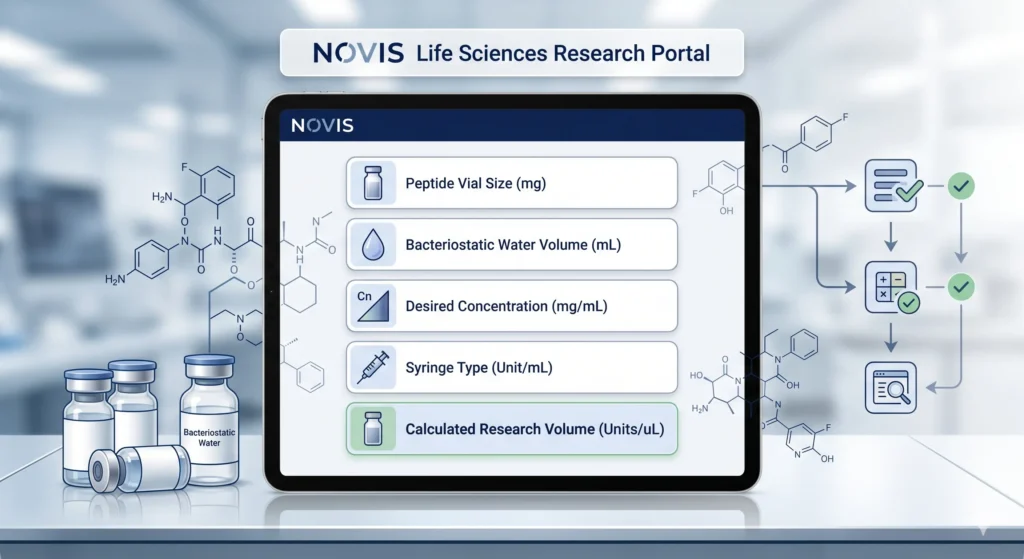
Peptide research requires precision. A small math mistake can change the concentration of a vial, the amount drawn into a syringe, or the way a research protocol is organized. That is why Novis Life built its Peptide Reconstitution Calculator, also called the Reconstitution Tracker.
The Novis Life tracker is designed to help researchers calculate three important things: how much bacteriostatic water to add to a peptide vial, what the final concentration will be, and how much volume corresponds to a selected research dose.
It is not medical advice. It is not a prescription tool. It is a research calculator built to make peptide reconstitution math easier, cleaner, and more organized.
What Is the Novis Life Peptide Tracker?
The Novis Life peptide tracker is a research tool that helps calculate peptide reconstitution and dose volume.
In simple terms, it helps answer questions like:
How much bacteriostatic water should be added to a vial?
What concentration will the vial have after reconstitution?
How much liquid equals a selected microgram amount?
How does that translate to a syringe measurement?
This matters because peptides often come as lyophilized powder. Before a research compound can be measured in liquid form, the powder needs to be reconstituted with bacteriostatic water. Once that happens, the concentration depends on two numbers: the amount of peptide in the vial and the amount of liquid added.
The tracker helps make that math easier.
Why Reconstitution Math Matters
Peptide research often involves milligrams, micrograms, milliliters, and syringe units. That can get confusing quickly.
For example, a vial may contain peptide powder measured in milligrams. A research amount may be discussed in micrograms. The bacteriostatic water is measured in milliliters. A syringe may be marked in units.
That means the user has to convert between several different measurements.
The Novis Life tracker is useful because it organizes those calculations in one place. Instead of trying to do the math manually, the user can enter the key values and let the calculator show the volume needed.
Step One: Start With the Peptide Vial Size
The first step is identifying the vial size.
This usually means the amount of peptide in the vial, measured in milligrams. For example, a research vial may be labeled as 5 mg, 10 mg, or another amount.
This number matters because it tells the calculator how much total peptide is in the vial before bacteriostatic water is added.
The vial size is one of the foundation numbers in the calculation.
Step Two: Choose the Bacteriostatic Water Volume
The next step is deciding how much bacteriostatic water will be added to the vial.
Bacteriostatic water is used to reconstitute lyophilized peptide powder. The amount added changes the final concentration.
Adding less water creates a more concentrated vial.
Adding more water creates a more diluted vial.
Neither is automatically better. The right volume depends on the research setup, the desired concentration, the syringe type, and how easy the final volume is to measure.
This is where the Novis Life tracker becomes useful. It helps translate vial size and water volume into a clear concentration.
Step Three: Understand the Final Concentration
After the peptide powder is mixed with bacteriostatic water, the vial has a final concentration.
Concentration means how much peptide is present in a certain amount of liquid.
For example, the calculator may help show how much peptide is contained per milliliter or how much liquid corresponds to a selected microgram amount.
This is the most important part of reconstitution math. Without knowing concentration, the user cannot accurately calculate volume.
Step Four: Enter the Desired Research Amount
After concentration is calculated, the next step is entering the desired research amount in micrograms.
This does not mean the tracker is giving a dose recommendation. It is not. The user supplies the amount, and the calculator converts that amount into a volume based on the vial concentration.
This is an important distinction.
The tracker does not decide what peptide amount should be used. It helps calculate how much liquid corresponds to the amount the user enters.
Step Five: Select the Syringe Type
The tracker also helps connect the calculation to syringe measurement.
This matters because syringes are not always marked the same way. A U-100 insulin syringe, for example, uses unit markings that need to be understood correctly.
The calculator helps reduce confusion by connecting the desired research amount to the injection volume.
This can make it easier to understand how a calculated volume appears on a syringe.
Step Six: Follow the Reconstitution Process Carefully
Novis Life outlines a simple reconstitution process:
Gather supplies, including the lyophilized peptide vial, bacteriostatic water, alcohol swabs, and a properly sized syringe.
Determine the bacteriostatic water volume using the calculator.
Draw the calculated amount of bacteriostatic water.
Inject the bacteriostatic water slowly along the inside wall of the peptide vial.
Gently swirl the vial until the powder dissolves.
Calculate the dose volume by entering the desired research amount and syringe type.
One important handling point is that the vial should be gently swirled, not shaken. Shaking can be too aggressive for delicate compounds.
What the Tracker Helps Prevent
The Novis Life tracker is useful because peptide math mistakes are common.
It can help reduce confusion around:
Milligrams versus micrograms.
Water volume.
Final concentration.
Dose volume.
Syringe markings.
Overly concentrated mixtures.
Overly diluted mixtures.
Manual calculation errors.
This is why a calculator-style tool is valuable. It creates a clearer workflow instead of relying on guesswork.
What the Tracker Does Not Do
The Novis Life tracker does not replace medical advice.
It does not prescribe peptides.
It does not tell someone what peptide to use.
It does not determine whether a peptide is safe.
It does not verify whether a product is sterile or authentic.
It does not create a medical protocol.
It does not replace a licensed healthcare provider.
The tracker is best understood as a research math tool. It helps calculate liquid volumes after the user enters the relevant research values.
Why It Fits Into the Novis Life Research System
The tracker is one part of the larger Novis Life research platform.
The Peptide Library helps users understand individual compounds.
The Stack Finder helps organize research goals into a structured research profile.
The Reconstitution Tracker helps calculate vial concentration and volume.
The Journal helps explain peptide categories, research trends, and safety topics.
Together, these tools make Novis Life more than a simple peptide directory. The site is built around organization, research education, and protocol clarity.
Who the Tracker Is For
The tracker is best suited for people trying to understand peptide research math in a more organized way.
It can be useful for researchers, educators, peptide content creators, and anyone trying to understand how reconstitution calculations work.
It is especially useful for people who are confused by the difference between milligrams, micrograms, milliliters, and syringe units.
Why the Tracker Matters
Peptide research is already complicated. The math should not make it more confusing.
The Novis Life tracker helps simplify one of the most common pain points in peptide research: turning a dry vial into a measurable liquid concentration.
That makes the tool valuable because it supports clarity. Instead of guessing how much water to add or how much volume equals a selected research amount, the tracker gives a more structured calculation.
A Simple Example of How to Think About It
The basic concept is:
Vial size tells you how much peptide is in the vial.
Water volume tells you how diluted or concentrated the vial becomes.
Desired research amount tells you how much peptide you are trying to measure.
The calculator converts that into liquid volume.
That is the core purpose of the tracker.
It does not decide the research amount. It translates the numbers.
Safety and Research-Only Reminder
Novis Life clearly frames its tools as research-only and not medical advice. That disclaimer matters.
Peptides can be biologically active, and injectable products require careful attention to sterility, source quality, storage, and handling. Any peptide-related decision involving human use should involve a licensed medical professional.
The tracker should be used as an educational and research calculation tool, not as a substitute for clinical guidance.
Final Takeaway
The Novis Life Peptide Reconstitution Tracker helps make peptide research math easier to understand. It allows users to enter vial size, bacteriostatic water volume, desired research amount, and syringe type so they can calculate concentration and volume more clearly.
Its main value is organization. It helps reduce confusion around reconstitution, concentration, and syringe measurement.
For anyone studying peptide research, the tracker is useful because it turns a confusing math process into a step-by-step workflow. It does not give medical advice, prescribe peptides, or create treatment protocols. It simply helps users understand the numbers behind peptide reconstitution.
Outbound Links
Novis Life Peptide Reconstitution Calculator
Use this source for the peptide tracker and reconstitution workflow.
https://www.novislife.com/reconstitution-tracker/
Novis Life Peptide Library
Use this source for the full research catalog of peptide compounds.
https://www.novislife.com/peptides/
Novis Life Stack Finder
Use this source for the research stack-matching tool.
https://www.novislife.com/stack-finder/
Novis Life Journal
Use this source for peptide education, research notes, and protocol-related articles.
https://www.novislife.com/blog/
Novis Life About Page
Use this source for the platform’s research-focused positioning and tools.
https://www.novislife.com/about/