MOTS-c and SS-31: The Mitochondrial Peptides Behind the Cellular Energy Conversation

Energy is one of the biggest topics in health, fitness, longevity, and peptide research. People want more wakefulness, better stamina, stronger workouts, improved recovery, and less daily fatigue. But real energy is not just about caffeine, pre-workout, or stimulation. At the cellular level, energy is deeply connected to the mitochondria.
Mitochondria are often called the powerhouses of the cell because they help produce ATP, the energy currency cells use to function. When mitochondrial function is healthy, the body is generally better equipped to manage metabolism, movement, recovery, and stress. When mitochondrial function is impaired, energy production, oxidative stress, muscle performance, and metabolic flexibility may all be affected.
This is where mitochondrial peptides have become part of the conversation. Two of the most discussed are MOTS-c and SS-31. They are not the same peptide, and they do not work the same way, but both are tied to mitochondrial research, cellular energy, and metabolic resilience.
What Are Mitochondrial Peptides?
Mitochondrial peptides are peptides connected to mitochondrial function, signaling, or protection. Some are naturally encoded within mitochondrial DNA, while others are synthetic peptides designed to target the mitochondria.
This matters because mitochondria are not just energy factories. They also help regulate oxidative stress, cell survival, inflammation, metabolism, and adaptation to stress. Research on mitochondrial-derived peptides has expanded because scientists are increasingly seeing mitochondria as signaling hubs, not just passive engines.
MOTS-c and SS-31 represent two different sides of this field. MOTS-c is discussed as a mitochondrial-derived peptide involved in metabolic signaling. SS-31, also known as elamipretide, is discussed as a mitochondria-targeting peptide that interacts with the inner mitochondrial membrane.
What Is MOTS-c?
MOTS-c stands for mitochondrial open reading frame of the 12S rRNA-c. It is a mitochondrial-derived peptide encoded by mitochondrial DNA.
MOTS-c is studied because it appears to play a role in metabolic regulation, skeletal muscle glucose metabolism, stress adaptation, and aging-related pathways. Reviews describe MOTS-c as a peptide involved in energy metabolism, stress homeostasis, and communication between the mitochondria and nucleus. (PMC)
One reason MOTS-c gets attention in the energy conversation is its relationship to skeletal muscle. A 2016 study reported that MOTS-c targets skeletal muscle and enhances glucose metabolism, which connects it to research around insulin resistance, obesity, and metabolic health. (PubMed)
In exercise research, MOTS-c has also been described as an exercise-induced mitochondrial-encoded regulator. A Nature Communications study reported that exercise increased MOTS-c expression in humans, while MOTS-c treatment improved physical performance and regulated skeletal muscle metabolism in mice. (Nature)
That does not mean MOTS-c is a proven energy treatment for humans. It means the research interest is connected to how cells manage fuel, stress, glucose metabolism, and adaptation.
What Is SS-31?
SS-31 is also known as elamipretide, MTP-131, or Bendavia. It is a mitochondria-targeting tetrapeptide, meaning it is made of four amino acids and is designed to interact with mitochondria.
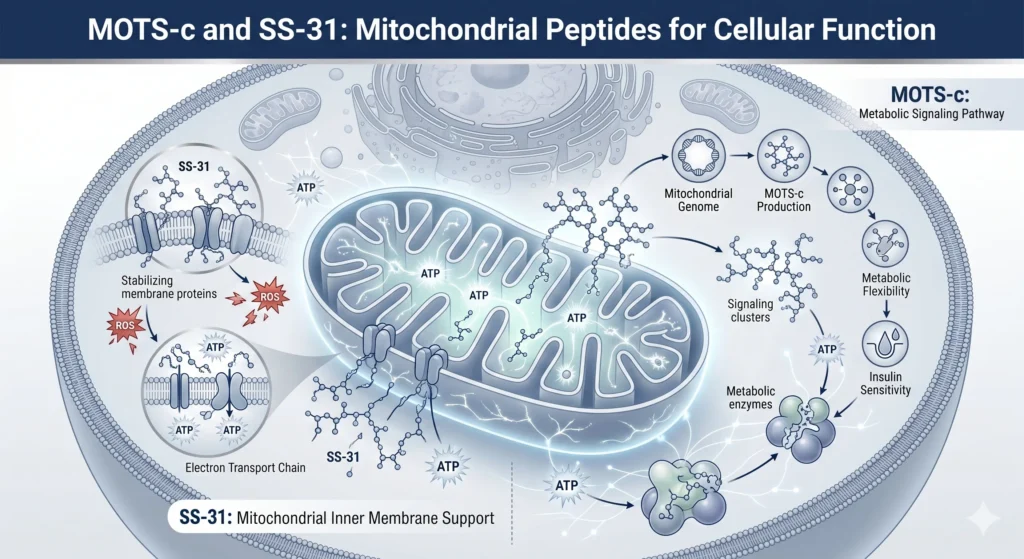
The key target for SS-31 is cardiolipin, a phospholipid found in the inner mitochondrial membrane. Cardiolipin helps maintain mitochondrial structure and supports electron transport chain function. Reviews describe elamipretide as a peptide that binds cardiolipin and is designed to improve mitochondrial dysfunction by supporting inner mitochondrial membrane function. (PMC)
That is why SS-31 is often discussed in relation to mitochondrial efficiency, oxidative stress, and cellular energy. The peptide is not generally framed as a stimulant. Instead, it is discussed as a compound that may support mitochondrial structure and bioenergetics.
A major regulatory development also matters here: in September 2025, the FDA granted accelerated approval to elamipretide injection under the brand name Forzinity as the first treatment for Barth syndrome in patients weighing at least 30 kg. Barth syndrome is a rare mitochondrial disease. (U.S. Food and Drug Administration)
That approval is important, but it should not be misrepresented. It does not mean SS-31 is approved as a general energy, anti-aging, workout, or wellness peptide. It means elamipretide has an approved use in a specific rare mitochondrial disorder.
MOTS-c vs SS-31: What Is the Difference?
MOTS-c and SS-31 are both tied to mitochondria, but they are not interchangeable.
MOTS-c is best understood as a mitochondrial-derived signaling peptide. It is discussed for metabolic regulation, glucose metabolism, stress adaptation, and skeletal muscle energy pathways.
SS-31 is best understood as a mitochondria-targeting peptide that interacts with cardiolipin in the inner mitochondrial membrane. It is discussed for mitochondrial membrane function, oxidative stress, and mitochondrial bioenergetics.
A simple comparison:
| Peptide | Main research identity | Energy connection |
|---|---|---|
| MOTS-c | Mitochondrial-derived signaling peptide | Metabolic regulation, glucose handling, skeletal muscle adaptation |
| SS-31 | Mitochondria-targeting cardiolipin-binding peptide | Mitochondrial membrane support, oxidative stress, ATP-related research |
The cleanest way to say it is this: MOTS-c is more about metabolic signaling, while SS-31 is more about mitochondrial protection and structure.
Why Mitochondrial Function Matters for Energy
Energy is not just a feeling. It is a biological process.
Every workout, thought, heartbeat, muscle contraction, and repair process requires energy. Mitochondria help convert nutrients into ATP, and ATP powers cellular work.
When people talk about wanting more energy, they may actually be talking about several different issues:
Poor sleep.
Low calorie intake.
Poor blood sugar control.
Low mitochondrial efficiency.
High oxidative stress.
Overtraining.
Poor recovery.
Inflammation.
Nutrient deficiencies.
Medication effects.
This is why peptides like MOTS-c and SS-31 attract attention. They connect to the deeper cellular machinery behind energy rather than simply stimulating the nervous system.
MOTS-c and Metabolic Flexibility
Metabolic flexibility is the body’s ability to shift between fuel sources, such as glucose and fat, depending on need. In healthy metabolism, the body can adapt to exercise, fasting, feeding, and stress.
MOTS-c is interesting because it has been linked to skeletal muscle metabolism and glucose handling. Research reviews describe MOTS-c as being involved in glucose metabolism, insulin sensitivity, lipid metabolism, and aging-related metabolic pathways. (PMC)
This makes MOTS-c relevant to conversations about metabolic health, exercise adaptation, and cellular resilience. But the important phrase is “relevant to research,” not “proven to increase energy in humans.”
SS-31 and Mitochondrial Stress
Mitochondria can be damaged by oxidative stress. Oxidative stress happens when reactive oxygen species exceed the body’s ability to manage them. Some reactive oxygen species are normal and even useful for signaling, but excessive oxidative stress can damage mitochondrial DNA, proteins, and lipids.
SS-31 is studied because of its relationship with cardiolipin and the inner mitochondrial membrane. A 2025 review explained that elamipretide may improve electron transport chain efficiency and reduce electron leakage, which is a major source of reactive oxygen species production in mitochondria. (PMC)
That is why SS-31 is often discussed in mitochondrial disease, aging, heart, muscle, and neurodegenerative research spaces.
Are MOTS-c and SS-31 “Energy Peptides”?
They are often marketed that way, but a more accurate phrase would be mitochondrial peptides connected to energy research.
MOTS-c is connected to energy because it is involved in metabolic signaling, glucose handling, and skeletal muscle adaptation.
SS-31 is connected to energy because it targets mitochondria and cardiolipin, which are central to mitochondrial structure and ATP-related function.
Neither should be described as a guaranteed fix for fatigue, a replacement for sleep, or a stimulant. The credible message is that both peptides are part of the scientific conversation around mitochondrial function and cellular energy.
Why the Longevity World Talks About These Peptides
Longevity research is increasingly focused on mitochondrial function because aging is associated with changes in cellular energy, oxidative stress, inflammation, metabolic flexibility, and tissue repair.
MOTS-c is often discussed in longevity circles because mitochondrial-derived peptides may act as signals that help the body respond to stress and metabolic demand. SS-31 is discussed because mitochondrial membrane integrity and oxidative stress are major themes in age-related decline.
The key is not to overstate the evidence. These peptides are scientifically interesting, but general anti-aging claims require caution. A peptide can be promising in mitochondrial research without being proven as a broad longevity therapy.
Safety and Regulatory Notes
The safety conversation is different for MOTS-c and SS-31.
MOTS-c remains primarily a research peptide in the wellness conversation. It does not have an FDA-approved consumer indication for energy, weight loss, longevity, or metabolic enhancement.
SS-31, as elamipretide, has an FDA-approved form for Barth syndrome, but that approval is specific. It should not be treated as approval for general wellness use, fatigue, workouts, or anti-aging.
For any peptide, product quality matters. Peptides sold online may vary in purity, sterility, identity, and concentration. This is especially important with injectable products.
Final Takeaway
MOTS-c and SS-31 are two of the most important mitochondrial peptides in the cellular energy conversation.
MOTS-c is a mitochondrial-derived peptide studied for metabolic signaling, glucose metabolism, skeletal muscle adaptation, and stress response.
SS-31 is a mitochondria-targeting peptide studied for its interaction with cardiolipin, mitochondrial membrane function, oxidative stress, and mitochondrial bioenergetics.
They are not caffeine. They are not simple energy boosters. They are part of a deeper conversation about how mitochondria regulate cellular fuel, stress adaptation, and long-term metabolic health.
The responsible way to discuss them is this: MOTS-c and SS-31 may relate to cellular energy because they are connected to mitochondrial biology, but their real-world use depends on evidence level, regulatory status, product quality, and medical oversight.
Scientific biotech illustration showing mitochondria, peptide chains, ATP energy particles, and cellular signaling pathways representing MOTS-c and SS-31 research related to mitochondrial function and cellular energy.