Novis Peptide News (May 22, 2026): Retatrutide Takes the Spotlight as Peptide Safety Scrutiny Builds

For the week of May 16 through May 22, 2026, the biggest peptide news was clear: Retatrutide moved closer to the center of the obesity-drug conversation after Eli Lilly released Phase 3 TRIUMPH-1 results.
The week also brought renewed attention to peptide regulation, compounding, online “research peptide” sales, and the growing divide between clinically studied peptide drugs and unverified gray-market products.
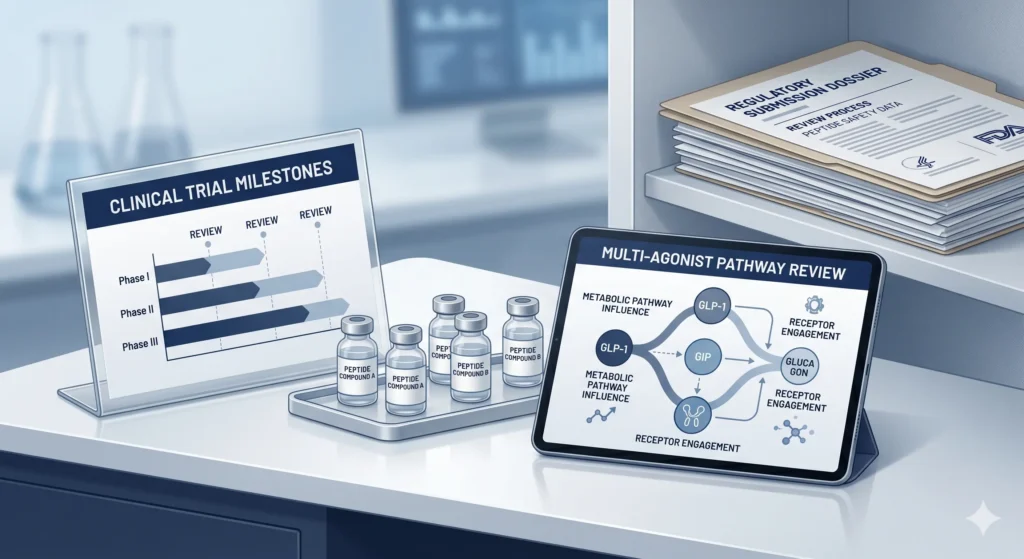
The short version: peptide science is accelerating, but so is the safety conversation.
Retatrutide Phase 3 Data Became the Biggest Peptide Story of the Week
On May 21, 2026, Eli Lilly announced Phase 3 results from the TRIUMPH-1 trial of Retatrutide, its investigational triple hormone receptor agonist for obesity. In the trial, participants receiving the 12 mg dose lost an average of 70.3 pounds, equal to 28.3% of body weight, over 80 weeks. Lilly also reported that 45.3% of participants on the 12 mg dose achieved at least 30% weight loss. (Eli Lilly and Company)
That level of weight loss drew immediate attention because it moves Retatrutide into a different category of public discussion. The Guardian reported that the results appear to outperform current obesity drugs on the market, noting that Retatrutide combines activity at GLP-1, GIP, and glucagon receptors. (The Guardian)
Reuters also reported that Lilly’s trial involved adults with obesity or overweight without diabetes and that more than 45% of participants on the highest dose lost at least 30% of body weight. Reuters noted that Lilly may now be positioned to seek regulatory approval, with a possible commercial launch next year depending on the FDA process. (Reuters)
Why Retatrutide Is Different From Semaglutide and Tirzepatide
The reason Retatrutide is getting so much attention is its triple-receptor design.
Semaglutide works through the GLP-1 receptor. Tirzepatide works through GIP and GLP-1 receptors. Retatrutide is designed to activate GIP, GLP-1, and glucagon receptors.
BioPharma Dive described this as the next step in Lilly’s obesity-drug strategy, explaining that Retatrutide builds on the GLP-1 and GIP pathway approach by adding glucagon receptor activity. The publication also noted that investors are watching the drug closely because of its potential to extend Lilly’s obesity portfolio. (BioPharma Dive)
For consumers, the important distinction is regulatory status. Semaglutide and Tirzepatide have FDA-approved uses. Retatrutide remains investigational.
Side Effects Remain Part of the Story
The excitement around Retatrutide should not erase the safety conversation.
The Guardian reported that side effects in the trial included nausea, vomiting, diarrhea, and constipation, with side effects increasing by dose. (The Guardian) MarketWatch also reported that about 11% of participants on the highest dose discontinued treatment because of side effects, while nausea and diarrhea were among the most common issues. (MarketWatch)
That matters because the next phase of obesity-drug development is not only about producing more weight loss. It is about producing weight loss that people can tolerate over time.
A drug can look powerful on paper, but long-term use depends on side effects, dose escalation, adherence, nutrition, muscle preservation, and medical monitoring.
The Online Retatrutide Market Is Moving Faster Than Approval
One of the most important safety issues is that public interest in Retatrutide is already moving faster than the regulatory process.
Investor’s Business Daily reported this week that Lilly’s unlaunched weight-loss drug is already being copied and sold online, even though Retatrutide is not FDA-approved. The report described unauthorized versions as part of a broader black-market and gray-market problem in weight-loss peptides. (Investors.com)
This is a critical point for peptide education. A clinical-trial compound made under regulated research conditions is not the same as a vial sold online as a “research peptide.” The name may be the same, but the product may not have the same identity, purity, sterility, concentration, or safety oversight.
The FDA has already warned that some companies are illegally selling unapproved products containing Semaglutide, Tirzepatide, or Retatrutide while labeling them “for research purposes” or “not for human consumption.” The agency says these products may be of unknown quality and may be harmful. (U.S. Food and Drug Administration)
FDA Peptide Compounding Debate Continued During the Week
The other major peptide story was regulation. Forbes published an explainer on May 20, 2026, covering the FDA’s potential move to loosen restrictions on certain peptides this summer. The article focused on consumer questions around safety, legality, and peptide access. (Forbes)
The regulatory context goes back to the FDA’s July 2026 Pharmacy Compounding Advisory Committee meeting. The agency says the committee will discuss whether several peptide-related bulk drug substances should be considered for the 503A Bulks List, including BPC-157-related substances, TB-500-related substances, MOTS-c-related substances, DSIP-related substances, Semax-related substances, and Epitalon-related substances. (U.S. Food and Drug Administration)
That does not mean these peptides are FDA-approved. It means the FDA is evaluating whether certain bulk substances may be permitted for compounding under specific conditions.
This distinction matters. “Potentially allowed for compounding” is not the same as “approved as safe and effective.”
What This Week Means for the Peptide Industry
The May 16 through May 22 news cycle shows two peptide markets moving at the same time.
The first market is the clinical market. This includes companies like Lilly running large Phase 3 trials, collecting safety data, measuring body weight, tracking side effects, and preparing for FDA review.
The second market is the consumer peptide market. This includes online sellers, wellness clinics, research-use products, social media claims, and gray-market demand.
The gap between these two markets is where safety concerns grow.
A peptide can be scientifically promising and still be risky when sold outside proper oversight. A compound can be in clinical trials and still not be approved. A product can use the same name as a studied drug and still not match the actual research compound.
The Big Takeaway
This week’s peptide news was dominated by Retatrutide, and for good reason. The Phase 3 TRIUMPH-1 data suggests that next-generation triple agonists may push obesity-drug results beyond the current GLP-1 era.
But the safety message is just as important as the weight-loss message.
Retatrutide is not FDA-approved. Online versions should not be treated as equivalent to the clinical-trial drug. And the broader peptide market is still facing serious questions about compounding, sourcing, sterility, dosing, and medical oversight.
The future of peptides may be powerful, but it has to be built on evidence, regulation, and quality control rather than hype.